

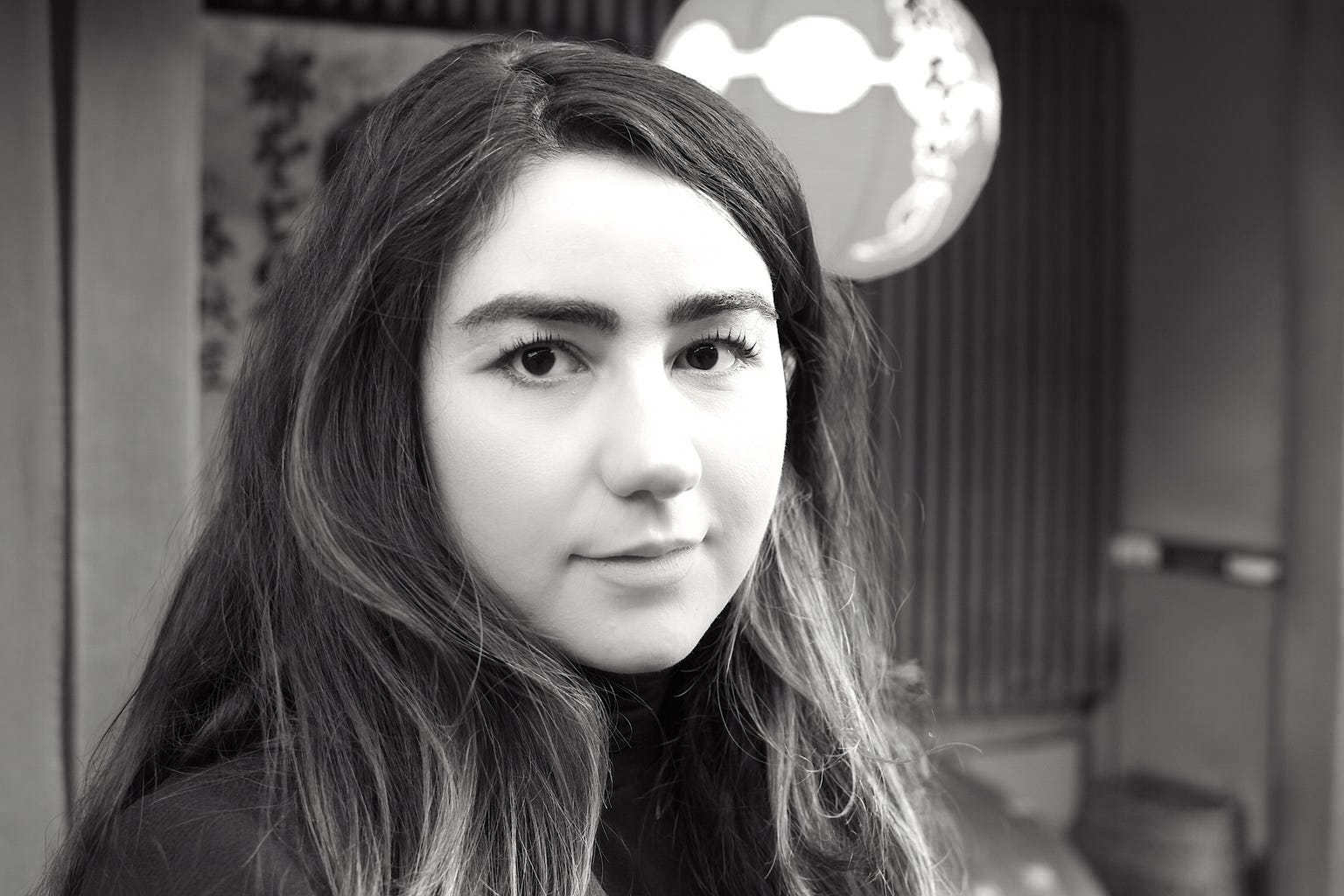
Ayten Tartıcı is a Turkish writer based in NYC. I first met her one humid summer in DC many years ago, when we were both college students interning at the capital. It wasn’t long before we began exchanging our poems with each other, and neither of us have stopped writing (or sharing for feedback) since. Ayten studied literature at Harvard (BA) and Yale (PhD), and her literary criticism, poetry, and translations have been published far and wide. These days she’s focusing more deeply on her fiction, and has been working on her creative projects as a 2025-2026 Susan Kamil Emerging Writer Fellow at The Center for Fiction, and was a 2025-2026 Writer-in-Residence at the James Merrill House. Her first published short story will be out in May.
This interview has been edited for length and clarity. 🇹🇷 Türkçe için tıklayın
You’re involved in so many forms of storytelling: photography, poetry, translation, short stories and essays. Which form of storytelling were you drawn to first?
I started writing poems in Turkish when I was around six years old. It was something uncontrollable. I would come home from school and try to finish my homework as quickly as possible so I could write. I quickly filled up notebook after notebook.
Did you share your poems with anyone?
For a long time, I kept my poems secret, but my friends and family knew that I was writing. During middle school and high school, I started sharing them. Like Emily Dickinson, I thought of poems as gifts, and I might offer them to a friend or to a love interest. They went from being something hidden to something that was exchanged and shared, to then something hidden again when I started college. As time went by, the nature of the poems kept changing.
Do certain forms of writing feel more playful to you, while others come with additional pressure?
I don’t feel any pressure when I’m writing fiction. It’s the same with literary criticism. Of course, with criticism, you are usually working under a deadline. You can’t edit endlessly. I’m forced to get it out the door. In that sense, there is some kind of pressure, but I’m able to lose myself in the process to such a degree that pleasure overpowers any sense of dread.
Poetry is where I might feel under the gun. Poetry is compression. As an art form, it is supposed to be tight. Despite that economy of language, Eliot once said of Dante’s Inferno, “genuine poetry can communicate before it is understood.” You can experience it before you wrap your head around it.
“I do believe in the religion of showing up every day.”
Do you remember your first published piece?
It was a calligram in English that was published in my high school literary journal. I was really into visual poetry at the time and very much under the influence of the French symbolists.
Do you remember the moment when you decided to commit yourself to a life of writing and literature? Or perhaps it was more of a slow migration?
At the end of high school, I realized that I wanted to become a writer, but I wasn’t sure yet how to make it work and what that life would look like. For a long time, I juggled a lot of things that took me away from my writing. I’ve always been a writer and a reader, but if you’re asking about total surrender, that only came in 2023.
That was the first time I had the courage to call myself a writer. I’m very hard on myself and I thought it was preposterous to call myself one because of the respect I felt for so many other intellectuals, novelists, and thinkers.
You’re currently at your first creative writing retreat at the James Merrill House. How has it been for you?
The first week, I felt like a fish out of water. I’m a homebody. I was in a new environment and it took me a while to get used to it. I sensed history all around me. Here I am, staying in the house of this poet that I really admire. I’m surrounded by his books, personal effects, and the relics of his life. The James Merrill House Foundation, the larger community in Stonington as well as the fellows have done a remarkable job preserving this space as a living, breathing sanctuary for writers. I was tip-toeing around the house at first, like I was on pins and needles. I also felt the presence of former fellows and the work they had produced in that space. In my time here, I started a small, experimental project. Beyond that, I spend my time reading Merrill and the work of former fellows, such as Henri Cole and ‘Pemi Aguda.
I’m also walking distance from the water, and because I grew up by the sea, it’s soothing. I am grateful to be here. The retreat became a way for me to meet new ideas on the page. And I met some incredible poets and made new friends in the community. I know I am a part of something that is greater than me.
How does the fact that you’re a literary critic play a role when you sit down to write creatively?
Critics who have tried to become creative writers have often failed miserably. Perhaps it’s a cautionary tale.
How would you say they’ve failed?
I recently had difficulty reading Elizabeth Hardwick’s Sleepless Nights, which she published in her early sixties and that difficulty wasn’t necessarily due to a lack of plot. Susan Sontag also wrote novels, but she is considered a brilliant essayist. We don’t necessarily think of her as a great novelist.
Why do you think that happens?
In Hardwick’s case, the reason might be that she came to fiction relatively late in life. By then, she was already established as a literary critic. I wonder whether that creates a certain pressure. Once you’re established in one genre, does moving into another feel like a risk? It’s a question I’m interested in, more broadly. In our generation, we see a great deal of crisscrossing between genres. Writers who we’ve long thought of as poets have published novels. We’ve grown accustomed to this fluidity. I think these lines have always been porous and they are meant to be crossed.
Does teaching literature nourish you as a writer?
I try to instill in my students the perspective that I am also looking to learn from them. And it’s true. Recently, one of them made a colored pencil drawing of Sappho’s Fragment 31. It’s a nude, showing a woman’s back. The lower half of her body is shaped like a candle; yet, it’s not the top of the candle that’s melting, but rather the bottom. When I first saw her drawing, I had to stop what I was doing that day. Sappho’s conception of eros as an inverted candle that’s melting from the bottom? Once I read her artist’s statement that it was a visual commentary on how desire can be a slow burn that is both conscious and unconscious, it changed my perspective about a poet that I’ve been teaching and reading for a long time.
What’s your writing process like?
I get completely absorbed in what I’m writing. Until my project is done, it’s what I live and breathe. Everything else in my life gets put on hold. I once forgot to pick up my daughter from daycare because I was fussing over a sentence and I am committed to never letting that happen again. Objectively, I spend too much time reading and researching.
For literary criticism, once I feel like I have a good grasp of my subject, I will then begin writing. Usually the writing itself takes less time. A piece has never taken me more than a week, but it’s the process leading up to it, the voluntary solitude I enter into, the amount of reading I undertake that prepares me for that moment of writing. It is about feeling authoritative. I do enjoy the editing process and entering into a dialogue with my editors, which feels like a reward.
These days, fiction happens on a daily basis. It’s an entirely different, cumulative approach. I try to write daily even if it’s just ten words. I do believe in the religion of showing up every day.
Do you set goals or deadlines, or is daily practice the only goal?
Over time, daily practice has become more important to me than deadlines.
Do you have a sense of the type of writer that you want to be known as?
I don’t think I want to be known for anything. I wouldn’t want to get in the way of the reader. They will make of the work what they will.
Do you see any themes emerge in my writing?
I’d say precision in language. You have a very strong respect for what you’re writing about. There’s a strong sense of, I’m writing about this because I deeply respect and honor what it’s about.
I see what you’re asking. I want my work to feel effortless. Whether that’s literary criticism, fiction, or poetry and no matter how much blood, sweat and tears have gone into it. I want the work to hide its labor. I want it to be seen as a moment’s thought, even if that wasn’t necessarily the case. I think that yearning comes from the urge that you identified correctly with me — not just respect for what I do, but also a love of precision. I want my writing to be crystalline, but I also want it to feel effortless.
What’s the greatest compliment you’ve received about your writing?
A few people in the past have memorized my writing and recited it back to me. One time it was a sentence from a review. One time it was a line from a poem. Another time it was a sentence from a short story. To me that’s the highest form of compliment, to occupy space in someone else’s mind and memory.
You grew up mostly in southern Turkey then moved to Istanbul for middle school. Did you move to Istanbul with your family?
I moved with my family but it was made very clear to me that they had moved because of me. We were initially going to move to Ankara where my dad was working at the time. But then, after I scored well on the national exam, my teachers urged my parents to find a way to make it work and instead send me to a school in Istanbul that they thought was a better fit for me. Literally hours before the deadline, my dad rushed to a government office and changed my school choices. Then the whole family ended up relocating to Istanbul, which was difficult for us the first couple of years. That put an extreme amount of pressure on me to perform well in school.
How has Istanbul inspired you as a storyteller?
I have a very complicated relationship with Istanbul. I usually visit with friends who are foreigners, and I’m able to experience it from their perspective. Each visit I get to see the city through different eyes.
Istanbul changes very rapidly and that change is something a lot of writers have written about. Those changes are very much in your face. There’s always a new building, new shops, a new highway. The city changes its face often, but time can slow down in other parts of the country. As an immigrant living in New York, being in Istanbul is a harsh reminder of the physical and emotional distance I have to Turkey, and I don’t like that. I’m sometimes entirely happy skipping Istanbul on my trips and flying to my hometown in southern Turkey where my family now lives.
The changes I encounter in my hometown are significant as well, but they’re subtle: a plant my mother has received or a set of new coffee cups. These tiny but not necessarily less important domestic changes tell you you haven’t been there for a while. But I find that kind of change easier to deal with than buildings that I’ve never seen. Of course this was before the earthquake.
I’m not saying I’m against change. It’s just that it takes a while to process. And sometimes if you’re visiting for a short time, it can be difficult to grapple with how you’re an immigrant in another country, and process your new position vis-à-vis your home country. It doesn’t mean I don’t find Istanbul inspiring. It’s just that I don’t think I’ve made peace with it yet.
Did you ever consider a different career path?
In high school, I briefly flirted with the idea of becoming a geneticist. I was very interested in these firebugs called Pyrrhocoris Apterus, which you can find under linden trees. They were everywhere on our school’s campus and I thought I could study the pattern variations on their wings. I kept them in glass jars in my bedroom until one day, my concerned father sat me down and asked, “Do you really want to spend the rest of your life looking through a lens?” While I never became a geneticist, I don’t think he realizes I’ve done exactly that.
Excellent interview! Thanks to you both